Painting
How to Calculate Paint for a Room
Wall area is the easy part. The decisions that change what you buy are what to subtract, what to estimate separately, and how a coverage figure on a can becomes whole containers.
Start with the wall area
Paint is estimated from the surface you're covering, so the first number is the area of the walls themselves. Measure the room's length and width, add them, double that for the perimeter, and multiply by the wall height. For a 10 × 12 ft room with an 8 ft ceiling that gives 2 × (10 + 12) = 44 ft of perimeter and 44 × 8 = 352 sq ft of wall.
That perimeter shortcut assumes four straight walls. If the room has an alcove, a chimney breast or a bay, the shortcut stops matching the room — measure each wall along its real length, multiply each by the height, and add the results. Don't include any imaginary line across the floor; there's no wall there to paint.
Subtract the doors and windows
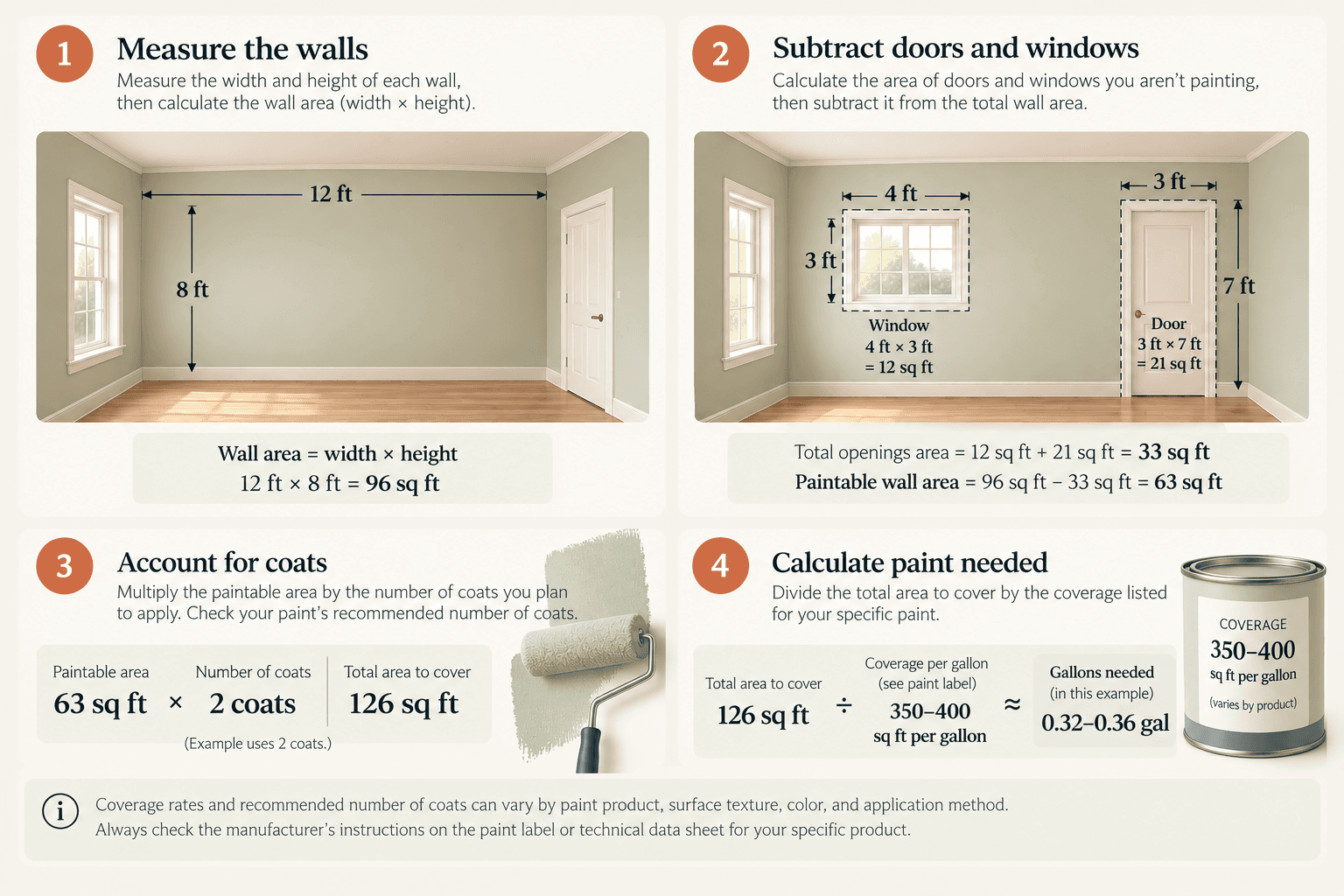
Measure each opening and take its area off the wall total.
A 3 × 7 ft door is 21 sq ft and a 4 × 3 ft window is 12 sq ft, so together they take 33 sq ft off the 352 above and leave 319 sq ft of paintable wall. There's no standard door or window size worth assuming here — measure the ones you have.
Leaving small openings in is a reasonable simplification: the result just carries a little extra paint as slack. What isn't safe is subtracting something you're actually going to paint. If the door and frame are getting painted, that's its own job with its own product and its own estimate, not a deduction from the wall figure.
The ceiling is a separate calculation
A ceiling is not extra wall area, and it shouldn't be folded into the wall total. It's a different surface with its own area — length × width, so 10 × 12 = 120 sq ft for the room above — and usually a different product, since ceiling paint and wall paint differ in finish and often in coverage.
Estimate it as its own job: its own area, its own number of coats, its own coverage figure, its own round-up to whole containers. Adding 120 sq ft to the wall area and dividing once would quietly assume the ceiling takes the same paint and the same number of coats as the walls, and would round the two together as though you could pour one into the other.
The Paint Calculator estimates walls only. To plan a ceiling, run it a second time with the ceiling's own area, coats and coverage — and keep the two results apart.
Coats multiply the area, once
Two coats over 319 sq ft is 638 sq ft of covering to do. The coats multiply the area, and that multiplication happens once — before you divide by coverage and before you round.
Rounding per coat and then multiplying is the common mistake, and it overbuys. Take 400 sq ft of wall and a paint covering 350 sq ft per gallon: one coat is 1.143 gallons, which rounds to 2, and doubling that gives 4 gallons. Doing it in the right order, 800 ÷ 350 is 2.286 gallons, so you buy 3. Same wall, same paint, one gallon of difference — because the leftover from the first coat is still in the tin when you start the second.
How many coats you need isn't something a calculator can settle. It depends on the product, the colour you're covering and the colour you're applying, the surface's condition and porosity, and whether you primed. Two is a common planning assumption and nothing more; follow the application instructions for the paint you bought.
Primer is its own estimate
Primer is a different product with its own coverage figure and its own number of coats, so it gets its own calculation rather than an extra coat added to the topcoat total. It often covers less per container than a finish paint, and bare drywall, patched repairs and a large colour change each change how much of it you need — which is exactly why the topcoat's numbers don't transfer.
Work out the primer separately over the same 319 sq ft, using the coverage printed on the primer you've chosen and the number of coats it calls for, then round that up to containers on its own. Whether you need primer at all is a question about the surface, not the arithmetic.
Coverage is a product figure, not a constant
Every estimate depends on how much area one container covers, and that number belongs to the specific product. Read it off the can or the manufacturer's product information for the paint you're buying.
Treat the printed figure as the number to start from rather than what you'll necessarily achieve. Porous, textured or freshly patched surfaces, the application method, how well the surface was prepared and a significant colour change can all mean less real coverage than the can suggests. The 350 sq ft per gallon used in the example below is an assumed figure for the arithmetic, not a value to apply to your paint.
What the arithmetic asks for vs. what you can buy
The division gives a theoretical quantity — 1.823 gallons, say. Paint is sold in fixed container sizes, so what you actually buy is whole containers, and the gap between the two is real money either left in a tin or left on the shelf.
- Round up, not down
- Running out mid-wall is worse than having some left: a second batch can differ slightly in colour, and a visible join where you stopped is hard to undo. Round the theoretical figure up.
- Container sizes change the answer
- A figure of 1.06 gallons rounds to 2 whole gallons and leaves you holding most of one. If the product also comes in quarts, a gallon plus a quart is much closer to what you need. Check what sizes your paint is actually sold in before deciding.
- Keep the leftovers deliberate
- Some surplus is useful for touching up later, and paint from the same container is the best possible match. Beyond that, surplus is just cost — so aim the round-up at a remainder you'd actually keep.
A worked example
The same room as the Paint Calculator's example. Every figure below other than the measurements is an assumption chosen to make the arithmetic concrete — 2 coats, 350 sq ft per gallon for the topcoat, 1 coat of a primer covering 300 sq ft per gallon. None of them are recommendations; use your own product's figures.
- Room
- 10 × 12 ft
- Wall height
- 8 ft
- Door
- 3 × 7 ft
- Window
- 4 × 3 ft
- Perimeter2 × (10 + 12) = 44 ft
- Gross wall area44 × 8 = 352 sq ft
- Openings21 + 12 = 33 sq ft
- Paintable wall352 − 33 = 319 sq ft
- Topcoat, 2 coats319 × 2 = 638 sq ft
- Topcoat at 350 sq ft/gal638 ÷ 350 ≈ 1.82 gal
- Topcoat to buy2 gallons
2 gallons of topcoat for the walls.
One round-up, and it comes last: 1.82 becomes 2. The coats multiply the area before the division, not after the rounding.
The primer is a second, independent calculation over the same wall area. One coat is 319 sq ft, and at an assumed 300 sq ft per gallon that's 319 ÷ 300 ≈ 1.06 gallons — which rounds up to 2 whole gallons and leaves about 0.94 of a gallon unopened. That remainder is the clearest example of the gap between the theoretical figure and the packaging: the arithmetic wanted a sixteenth over a gallon, and the shelf will sell you two. If the primer also comes in quarts, a gallon plus a quart covers it with far less waste.
The ceiling, if you're painting it, is a third calculation: 10 × 12 = 120 sq ft, two coats is 240 sq ft, and at an assumed 350 sq ft per gallon that's 0.69 gallons — 1 gallon to buy. Three separate estimates, three separate round-ups. Adding the areas together first would have blurred three different products into one number.
Common questions
Do I subtract doors and windows?
Can I just add the ceiling to the wall area?
How many coats will I need?
Do I need primer, and how much?
Why does the calculator round up to whole gallons?
Further reading
Where the figures for your own project come from:
Coverage rates and coat counts belong to the specific product, so there's no general figure worth quoting here. The authorities for your estimate are the label on the can you're buying and the manufacturer's product information for that line.