Flooring & Tile
How Much Extra Tile Should You Buy?
Tile is sold by the box and cut on site, so the number you buy is never the number the room needs. Here's what the extra is actually for, and how to decide how much of it you need.
What the extra is paying for
Overage is usually handed to you as a single percentage to add, and a round number like 10% hides the fact that the extra tile is doing four unrelated jobs. They scale with different things, which is why one percentage can't be right for every room.
- Cutting loss
- Every tile cut to meet a wall, a doorway or a pipe leaves an offcut. Sometimes the offcut is usable at the opposite edge; often it isn't the right size and is thrown away. This scales with how much perimeter and how many obstacles the room has relative to its area — which is why a small bathroom full of fixtures wastes a far higher proportion than a large open floor.
- Layout and pattern loss
- Where the layout starts and which way it runs decide how many tiles meet a wall part-way and what shape those offcuts are. A grid squared up to the walls tends to produce straight cuts, some of which can be reused at the opposite edge; a diagonal, herringbone, patterned or mosaic layout tends to produce more cuts and more awkward shapes with no second use. A pattern that has to repeat may also force you to discard otherwise good pieces to keep the run aligned. Where you set the starting line changes all of this, so it's worth planning the layout before settling on a figure.
- Breakage and defects
- Tiles break on the cutter, get dropped, and occasionally arrive chipped or out of tolerance. This is a small allowance on a forgiving tile and a real one on large-format, thin or natural stone pieces, which are more fragile to handle and to cut.
- Spares for later
- Tile held back deliberately so a cracked tile can be replaced in five years with a piece that matches. This one is different from the other three: it isn't consumed during the job, and it's the part people skip and later regret, because the same tile is often unavailable or a visibly different batch by then.
The first three are consumed while tiling. The fourth is a decision about the future, and it's worth deciding separately rather than hoping the percentage happens to leave enough behind.
Why a percentage is only a starting range
A single percentage is a convenient way to carry all four of those costs at once, and that convenience is the whole of its authority. There is no single waste percentage suitable for every project. Check the tile manufacturer's guidance and your installer's layout estimate. A cut-heavy or patterned layout needs a larger allowance than a plain grid, and a fragile or hard-to-match tile needs more again, but how much larger is a judgement about your room and your tile, not a fixed figure.
A percentage is a proxy for the things above, and the proxy is weakest exactly where it matters most. The same figure behaves differently on a large open rectangle than on a small room broken up by a toilet, a vanity and a door threshold, because cut-heavy edges are a much larger share of a small area. Tile size matters here too: a large tile spans more of the floor per piece, so a single cut wastes more of it than the same cut would of a small one. Judge it from your own dimensions, starting point, tile size and the cuts your layout actually produces.
Check the box: where the tile manufacturer or your retailer states an overage figure for a specific product or layout, use theirs over any general rule. They know the tolerances, the caliber and the breakage rate of that particular tile.
Three buying constraints that move the number
Once you have a percentage, how tile is actually sold changes what you end up with. These three often do more to set the final figure than adjusting the percentage does.
- You buy whole boxes, not tiles
- Tile is generally sold by the box, so your order rounds up to a whole box whatever the percentage says. That rounding is itself a source of spare tile — often enough to cover your spares on a small job, occasionally almost nothing if you land just over a box boundary. Work out the box count before deciding whether you need to add anything on top.
- Batches don't match
- Tile is produced in runs, and colour, shade and size tolerance can shift between them. A second order placed weeks later may be a different batch and visibly different on the floor, even with the same product code. Boxes are usually marked with shade and caliber codes — worth checking that yours match, and worth opening them to compare before the first tile goes down. This is the main practical reason to buy the whole job at once rather than topping up later.
- Returns have conditions
- Buying generously is only cheap if you can return the surplus. Policies differ on unopened boxes, special orders, time limits and restocking fees, and special-order tile is frequently non-returnable. Check the terms before you decide how much cushion to buy, and keep the boxes you might return unopened and undamaged.
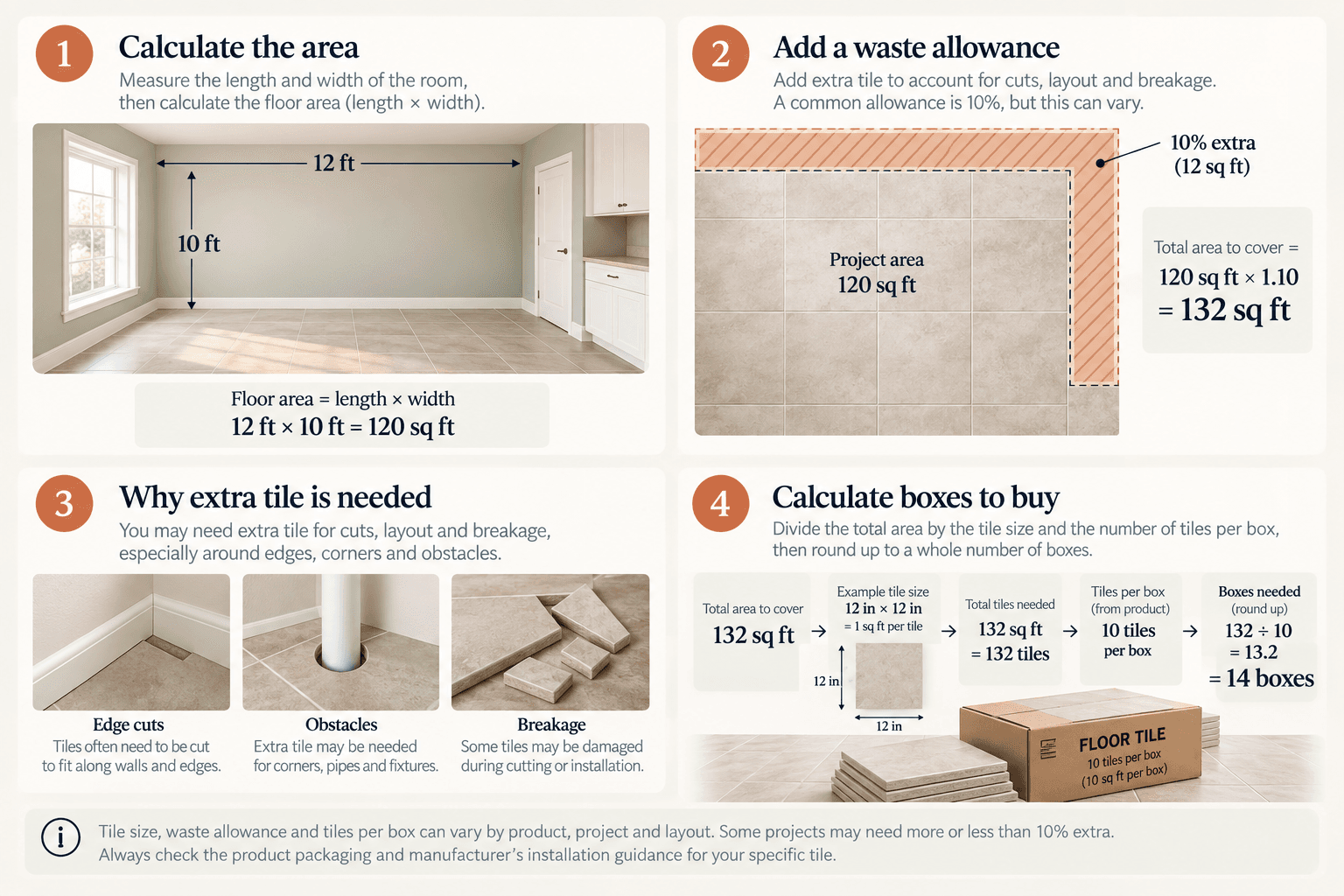
A worked purchase example
The same room as the Tile Calculator's example, looked at from the purchasing side. The 10% below is an assumed figure chosen to make the arithmetic concrete — not a recommendation for your room.
- Room
- 10 × 12 ft
- Tile
- 12 × 12 in
- Tiles per box
- 10
- Allowance
- 10%
- Field area10 × 12 = 120 sq ft
- Tiles for the field120 tiles
- After 10% allowance120 × 1.10 = 132 tiles
- Boxes needed132 ÷ 10 = 13.2 → 14 boxes
- Tiles actually bought14 × 10 = 140 tiles
- Spare beyond the field140 − 120 = 20 tiles
Buy 14 boxes — 20 tiles more than the floor needs.
12 of those 20 are the 10% allowance; the other 8 come from rounding up to a whole box.
The useful part is the last line. The allowance was 12 tiles, but rounding to whole boxes put 20 beyond the field — the cuts and breakage come out of those 20 first, and whatever is still whole at the end is what you keep. On a job this size that cushion is usually enough to leave a few spares without adding another box.
It can fall the other way, though. A 127 sq ft field of the same tile needs 139.7 tiles with the same 10% — that's 13.97 boxes, so you still buy 14. Those 140 tiles are 13 more than the 127 the floor needs, about 10.24%, but rounding up to the whole box only added 0.3 of a tile on top of the allowance you had already chosen. The cuts and any breakage draw down those 13 as the job goes, so what survives to go in the cupboard is some part of them, not all 13. Identical percentage, identical box count, and much less left over than the first job.
That's the habit worth taking away: run the numbers, look at what the rounding leaves you, and then decide whether the spares you want are already covered.
Common questions
Is 10% enough?
How many spare tiles should I keep?
Can I just buy more later if I run short?
Does the waste allowance replace measuring properly?
Further reading
Industry bodies that publish on tile selection and colour variation:
- Resource centre — Tile Council of North America
- Shade variation brochure (PDF) — Ceramic Tile Distributors Association
For any specific product, check the manufacturer's own datasheet and your retailer's return policy.